
A Day and a Half at 1 PH/s: Auditing Six Data Points
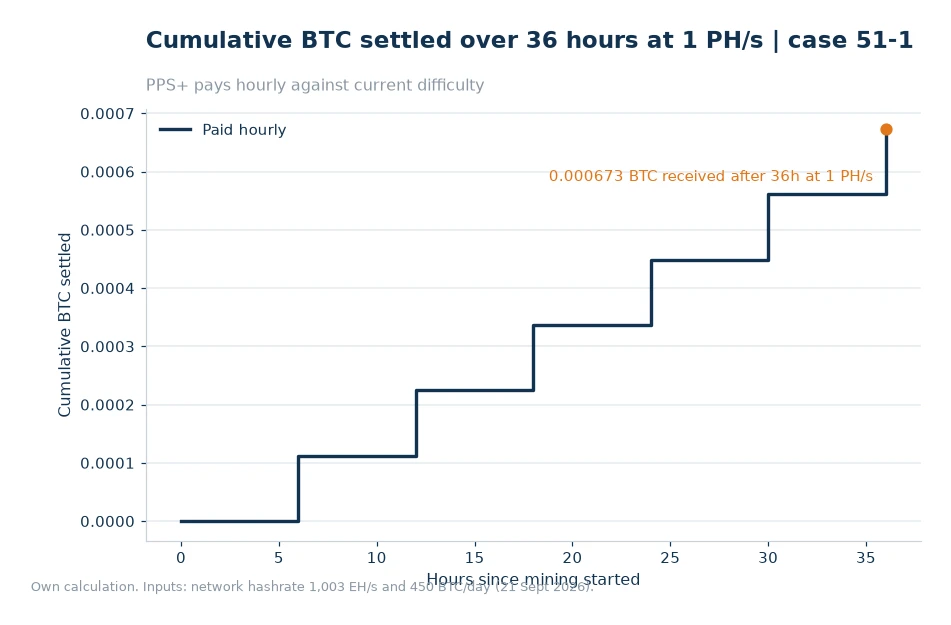
Thirty-six hours is a useful audit window because it spans more than one settlement cycle without covering a difficulty change often. At 1 PH/s the hourly credit is 0.000018692 BTC, so the run finishes at 0.00067291 BTC, or $56.99 at $84,692. Six data points are enough to check whether the account, the machine and the pool agree with each other.
Key takeaways
- Thirty-six hours at 1 PH/s credits 0.00067291 BTC, which is $56.99 at the reference price.
- Thirty-six hourly credits should arrive in that window when difficulty holds steady.
- The Pool Hashrate figure explains the pool's block rate; it does not set your credit.
- Check the machine's draw and the credited total in the same pass, since both can drift quietly.
Six points worth writing down
An audit does not need a spreadsheet with forty tabs. Six readings cover the ground: your hashrate as the pool sees it, the number of hourly credits in the window, the cumulative BTC, the fiat value at one fixed price, the machine's measured draw, and the pool's own hashrate for context. Take them in that order and the comparison stays honest.
The order matters because each reading narrows the next. If the credit count is short, the hashrate estimate or an interruption explains it. If the count is right but the BTC total is low, difficulty moved or the hashrate estimate was optimistic. If both look right and the fiat value is wrong, the price you used is stale. Working in sequence saves the guesswork that comes from comparing two figures with no shared reference.
Fix the price before the first reading and use the same one every week. Valuing a series at whatever the market did that morning turns a technical audit into a price chart, and the two questions get tangled. One number, written at the top of the page, keeps the BTC column honest and makes the fiat column a convenience rather than a second opinion.
The two local readings
A clamp meter on the feed and a thermometer at the inlet answer what the pool cannot see. Draw that has risen a few percent at the same hashrate usually means a power supply working harder or a fan compensating for a blocked filter. Draw that has fallen along with hashrate points at a board, a riser or a cable instead, and the two cases call for different tools.
Temperature is the slower variable. An inlet that climbs through the afternoon shifts efficiency without moving hashrate much, so the power bill rises while the credit stays flat. Logging the pair for a week separates a cooling problem from a hardware one, and that distinction decides whether the next conversation is with a supplier or with a repair bench.
The pool state view and the Profit Calculator cover the two ends of the same check: what the pool is doing, and what your hashrate should earn at current difficulty. Neither will tell you that a machine is running hot, which is why the local pair stays on the list.
Thirty-six hours in four marks
The table counts hourly credits rather than blocks, because hourly settlement is what the account actually receives. Each row should show one credit per hour when the machine runs without interruption.
| Hour mark | Credits so far | Cumulative BTC | Value at $84,692 |
|---|---|---|---|
| 6 | 6 | 0.00011215 | $9.50 |
| 18 | 18 | 0.00033645 | $28.49 |
| 30 | 30 | 0.00056076 | $47.49 |
| 36 | 36 | 0.00067291 | $56.99 |
A missing row is easier to spot in the credits column than in the BTC column, since thirty-five entries and thirty-six look almost identical once the numbers have six decimal places. Count the entries first, then check their sum.
Worked example
Start from the network totals and stop at the thirty-six-hour figure.
- Subsidy per day: 3.125 BTC × 144 blocks = 450 BTC.
- BTC per TH/s: 450 ÷ 1,003,107,267 = 0.00000044861.
- 1 PH/s is 1,000 TH/s: 1,000 × 0.00000044861 = 0.00044861 BTC a day.
- Per hour: 0.00044861 ÷ 24 = 0.000018692 BTC.
- Six hours: 6 × 0.000018692 = 0.00011215 BTC, or $9.50.
- Thirty hours: 30 × 0.000018692 = 0.00056076 BTC, or $47.49.
- Thirty-six hours: 36 × 0.000018692 = 0.00067291 BTC, and 0.00067291 × 84,692 = $56.99.
- One hour of downtime inside the window removes 0.000018692 BTC, about $1.58.
Where the pool's numbers stop and yours begin
The pool's figures describe a shared system. Pool hashrate, network hashrate and difficulty are properties of the whole, and none of them can be changed by one account. Their value to an individual miner is context: they explain why a credit is the size it is, and they predict the direction of the next change without promising its size.
Your own figures describe a single machine. Measured draw, inlet temperature, fan speed and the share count that reaches the pool are all local. When a credit disappoints, the local list is where the answer usually sits, because a pool that reports a steady hashrate for its other miners is unlikely to have lost only yours.
Difficulty is the shared number that lands most directly in your credit, and it moves at fixed intervals rather than smoothly. A 1% rise cuts the hourly credit by about 1%, which at 1 PH/s is roughly 0.00000019 BTC an hour. That is small in a single hour and visible across a month, so note the adjustment date before treating a slightly thinner series as a fault.
Opening the statistics view
The ViaBTC Mining Statistics page carries the shared figures, including network hashrate and difficulty, and it is the right place to start an audit rather than the end. Read the pool's share of the network first, then your own credit series, and keep the two separate in your notes so that a quiet pool week does not read as a personal failure.
If the pool's share has moved, the explanation is usually other miners joining or leaving, which no single operator controls. If it has not moved and your credits have, the cause is local. That single comparison removes most of the ambiguity from a disappointing day, and it takes about a minute to run.
Frequently asked questions
How many credits should 36 hours produce?
Thirty-six, one per hour, when the machine runs without interruption and difficulty holds; at 1 PH/s they add up to 0.00067291 BTC, worth $56.99 at $84,692.
Does the Pool Hashrate figure change my payout?
No. It describes the pool's share of network hashrate, which affects how often the pool finds blocks, while a PPS+ credit is settled per share against current difficulty.
What if one hourly credit is missing?
Compare the machine's own log with the credit history; a restart, a network drop or a share drought will usually appear in both, and one missing credit at 1 PH/s is 0.000018692 BTC.
Run the six readings once a week
Weekly is often enough for a steady operation and often enough to catch a trend before it costs a month. Write the six readings in the same order each time, and keep the previous week's numbers beside them. A single column that has drifted by a few percent is a question; four columns drifting together is a pattern.
Keep the audit page short. One line per week, six numbers and a note, is enough to spot a machine that is ageing before its credits make the case for you.
When the pattern appears, change one thing at a time. Cleaning a filter, swapping a PSU and moving a machine in the same afternoon leaves you with a better week and no idea which action earned it.
Sources: the ViaBTC statistics and pricing pages for panel definitions and the listed 4%[1]. Inputs read 21 Sept 2026: 1,003 EH/s, 132.76 T difficulty, 3.125 BTC per block, 144 blocks a day, BTC $84,692. Published 22 Oct 2026; all credits assume constant difficulty and no downtime.